
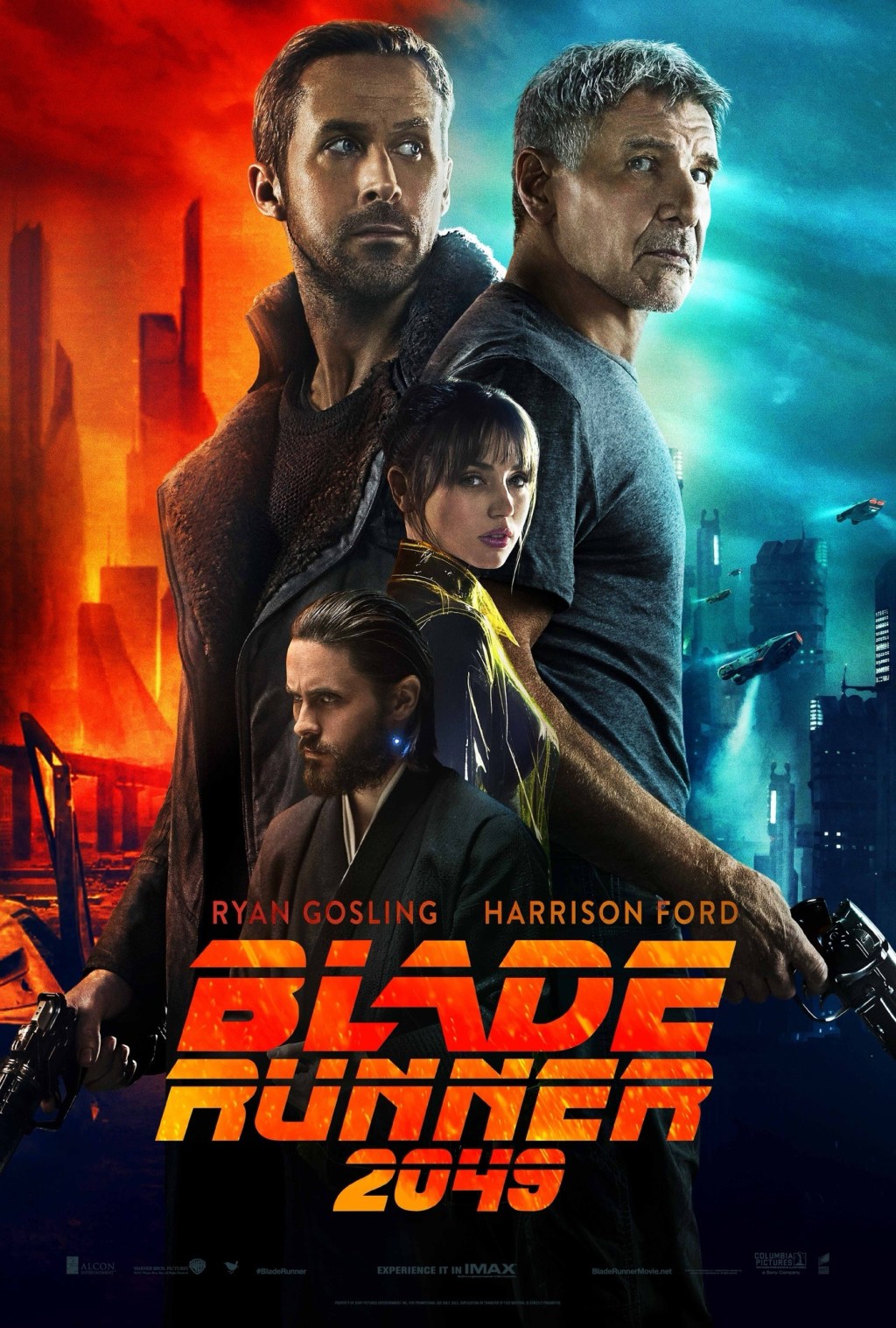
I sit before my computer wondering what I’m going to write for this blog. It’s been almost a week since I watched the movie and I can feel my memories begin to decay like computer data left in a faulty hard drive, only my brain’s not faulty, is it? Do I forget so I can make space for new memories or is entropy a part of the system? Even more frighteningly, can what is “forgotten” be remembered? This ties into the narrative of Blade Runner 2049 beautifully.
The main character, Agent K, is on a journey of remembrance, remembering himself, similar to Oedipus’ journey in Oedipus Rex. Past deeds, whether forgotten or seemingly benign in time, prove to be of utmost importance, leading Agent K to discover what is real and if his past has put him on a straight shot to his demise. Furthermore, fate is also a driving force between Agent K and Oedipus alike.
Agent K is on a neo-noir detective case of discovering if he is the first hybridized child between a replicant (synthetic human built for slave labor) and a human. As he discovers if he is, he unravels throughout the film which implications the reality/unreality may present.
Furthermore, due to believing—as a result of positive reinforcement by his AI girlfriend Joi, similar to how many AIs in our present age positively reinforce people into disillusionment—that he is the child of the synthetic and human, how will this knowledge affect his fate? If he never knew he was the first child to be born from the two, would his life have remained the same and stable? These questions are meaningless to the hero’s journey of self-knowledge.
Compared to Oedipus, who is crippled by learning that the evils of his fate have been actualized (fated to kill his father), Agent K discovers that he was never the child of a synthetic and human after all. At the end of the film, he is bloody and crippled, similar to the weakened Oedipus who walks on “three legs.” That is, using a cane and both legs in an age where he should only need two to walk.
Agent K’s memory that linked him to the true child was fabricated, implanted within him as a decoy from the true child who was too important to ever be in a position where she might get crippled like Agent K. The memory is that of the true hybrid’s toy horse. It is similar to Oedipus’ pierced ankles, pierced by his parents in hope he’d never stand to kill them.
The toy and the piercings hold both characters responsible to their fate. Only the child who was destined to kill his parents will have the pierced ankles, just as the child born of the two different kinds is the only child who would have this handmade horse of rare wood engraved with their birthdate. However, she is perfectly preserved by her fate compared to Oedipus and must endure no journey of self-knowledge or heroism as a result of being “the one”.
Regardless, there has to be someone who bears the burden of an unfortunate fate. Fitting for Agent K, the burden is one destined to be a slave should bear. However, it is important to note that Agent K’s heroism is largely a result of believing he is at least part human. If he did not hold this belief, even if false, he would likely have been incapable of doing things that replicants are largely incapable of, such as lying. By lying to himself, he may lie to the world.
Blade Runner 2049‘s specialism, for this reason, is not only in its stunning theatrics brought to reality by director Denis Villeneuve, but its twisting of the hero’s journey to self-knowledge. It begs the all too pertinent question for modern times: is there no meaning behind it all? Are all the puzzle pieces of self-discovery we assemble part of another’s image or of nothing at all? Hopefully, we can find peace in the pursuit of pointlessness and find value in the journey as it lasts.


Leave a comment