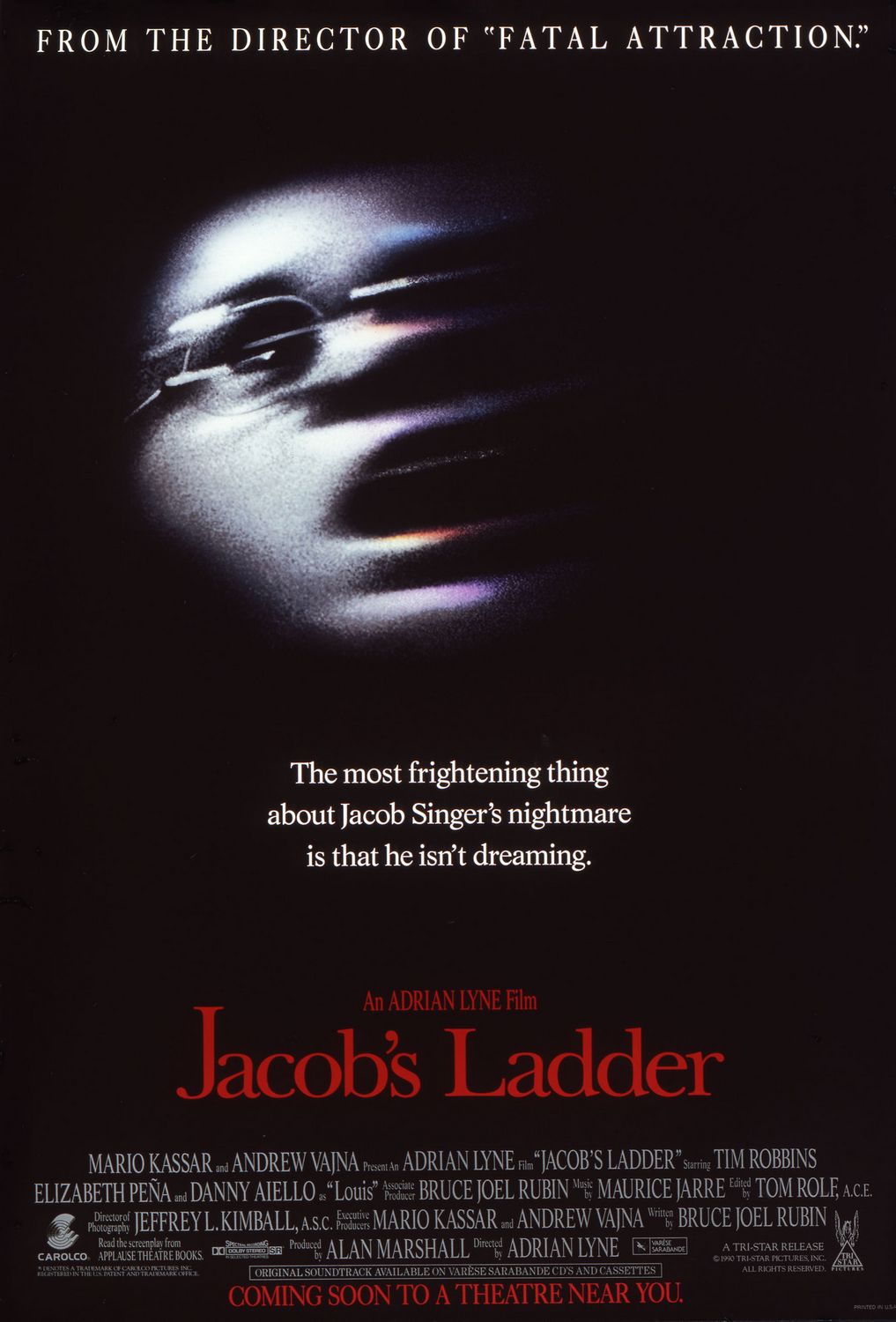
Jacob’s Ladder by Adrian Lyne is a fantastic film that delves deep into the inner workings of the protagonist’s mind while maintaining attachments to the material world. I don’t think the value of the film lies in trying to understand what is taking place—what is real and what is not—as something real can be simultaneously untrue, while something untrue can be simultaneously real. The film does this on purpose.
Because of this, no single factual conclusion can be made, other than how valuable the movie’s teachings are in terms of how we process life. The quote I have at the top of the blog post is important for this reason. Louis, Jacob’s chiropractor, is the one who delivers it. Described as an “oversized cherub,” he serves as one of the main figures of symbolic catharsis and positivity in Jacob’s life. He frequently intervenes when things go wrong for Jacob, knowing exactly the right thing to do, much like a guardian angel.
In contrast to the chiropractor is Jezzie, Jacob’s girlfriend. It is blatant that she represents a demonic figure within Jacob’s life, but at the same time, a relieving one as well. While the chiropractor relieves Jacob of physical tension, he also forces Jacob to confront his past by unlocking memories of Vietnam he had forgotten—memories seemingly “stuck” within his muscles, waiting to be freed. When the chiropractor aligns Jacob’s spine, he drops Jacob right back down the ladder, back into Vietnam. It is as if the traumatic memories he can’t let go of stored themselves in the exact pockets of physical tension they created long ago.
Compared to the chiropractor, Jacob’s girlfriend works with him through both body and mind. Jezzie’s methods of relief center around Jacob’s grief over his ex-wife and their past life together, which included a child who died. One day, a mysterious figure named Eli—a name with clear biblical resonance—gives Jacob an envelope of photos from his past life, including images of his deceased son. Jacob sees these photos and becomes visibly distraught. Jezzie, upset by Jacob’s distress, takes the photos and burns them in the stove—much like how a demon, as the quote suggests, burns away one’s earthly attachments and memories.
Jezzie is a key figure because, although Jacob struggles with her, she ultimately leaves him, not the other way around. As a result of being thrust into a paranoid-schizoid frenzy by his projected trauma, he perceives her natural aggression—stemming from her frustration with his catatonic state—as the threat of a literal demon. When she lashes out at him, her eyes turn black and her mouth stretches unnaturally. While Jezzie can be interpreted as a real person, she can also be viewed as a physical manifestation of a demon.
There are two major interpretations to draw from this film: an “inner” interpretation and an “outer” one. Either the events depict Jacob’s descent into madness as a result of severe trauma, or they portray the psychedelic, mind-altering experience occurring within Jacob’s mind as he dies on an operating table from a bayonet wound inflicted by a fellow soldier—a frenzy induced by “The Ladder,” a drug used by the government to unleash primal aggression.
Why Jacob appears back in the Vietnam barracks near the end if the rest of the film took place in real life remains ambiguous, but this ending allows both interpretations to exist simultaneously. Without it, the idea that everything occurred in his mind right before death would be less apparent. Regardless, the final scene of him ascending the stairs toward the light is beautiful, and the peaceful expression on his face in the field hospital provides a profound sense of closure.
The film is all about opposites. Real/unreal, angel/demon, attachment/loss, etc, Each one of these polarities eeem to be cared, especially in the case of Jacob’s son, the one who past away. Jacob’s son seems to be one of Jacob’s major attachments that he can’t quite let go of. He’s the child whose photo Jezebel burns and whose bike can be seen in the halls of a mental ward which Jacob is dragged into after waking from falling out of a car and telling the doctor that Santa stole his wallet. The thing is, like the story of the experimental drug called “the ladder” the idea of Santa stealing a wallet is very improbable. Now it didnt help that Jacob told the doctor Santa in the general form stole his wallet and not a Red Cross one. Regardless, I think this percieved Santa Claus delusion is valuable since it summarizes a lot of Jacob’s feelings throughout the film. Everything he sees is unbelievable and as he goes on his journey of discovering “the ladder’s” nature and the grand conspiracy behind it, Jacob is further plunged into the madness of truth vs. untruth by having a lot of his seemingly “delusional” beliefs being confirmed. Back to Jacob’s son.
When Jacob’s son is seen through a small and pale window attached to a door that Jacob looks out from a lot like how one might percieve a memory as being distored and hazy in one’s mind. the child can be seen riding out of view on the same bike he was killed on, telling Jacob, “I’m here, come follow me”. Just about before Jacob leaves through the door to find his child, a demon appears. It is the demon which represents the pain of not being able to let go of his child and enter the heavenly plane, whether that is a state of mind or the actual place. What I find intriguing is that Jacob does not touch his child’s hand, causing the child to appear or something, but it is the child himself who brings Jacob up the staircaise to heaven, which is an apartment staircase leading to a white abyss, not the actual staircase to heaven. He never really lets go of his child so to stay. What he is letting go of is the memories, not the person. Jacob has to realize that the child he loves is in heaven and not the real world. How he percieves the apparent loss of him must change. He must realize that the child was never lost, only forgotten. I am experiencing what I could call a state of catharsis or enlightenment as I write this. The idea of tearing away the emotional bond of a dead loved one is unimaginable. I can’t bear to think coping with the death of my grandfather by making myself think that he never existed. No, it is just my perception of him which must change to be something immortal. I can as easily remember him by the look on his face when he was happy and healthy as I can to the look on his face when he was old and sick. Life is full of opposites. One might only find a semblance and peace when looking at something which is indivisible, something immortal. I wish that I find this new perception in life, that I begin to go through my days lighter like the back of a person whose muscles have had tension released from. I wish to climb the ladder not by my own strength but by the freedom to ascend.
 Inklings of Epiphany
Leave a comment