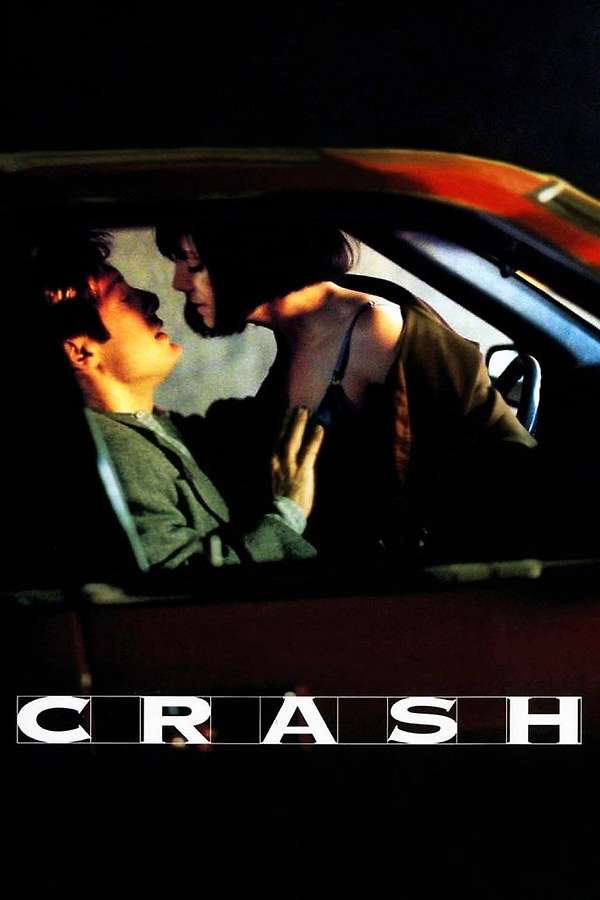
Crash by David Cronenberg is a fantastic film which delves into the psychosexual side of man’s relation to machine and the very act of a car crash being a freeing and cathartic action similar to that of an orgasm. In the beginning of the movie, the protagonist James, a film producer, crashes his car unexpectedly into that of Dr. Helen Remington and her husband’s automobile in a head on collision. This sends Helen’s husband out of the driver side window into Jame’s passenger seat, pitting James in direct view of the aftermath of his lucid driving’s consequence.
One can quickly see that Helen’s husband is not of the attractive type. He appears to be of older age compared to Helen and of a heavy set nature too. One can quickly infer by Helen’s follow up gesture of revealing her breast to James through her shattered window that she is to say “dissatisfied” with her relationship to her now ex-husband who she technically shares no further marital need to maintain fidelity. This is the beginning of Jame’s connection to the psychosexual side of cars, the danger they possess and how shared trauma will be the major catalyst to his sexual journey, along with the various other characters who will be introduced.
When James wakes from the hospital he is notified by his wife Catherine that the man he struck in the head on collision is dead, having died in a grotesque manor which forces James to recall the events in a state of discomfort. While this occurs, Catherine, seemingly detached and “turned on” by the grim events, is giving James some “manual labor” beneath his hospital bed sheets. One can tell that James is not as turned on as Catherine is, seeing him turn his head away from her and staring into the distance in a similar state of detachment, not of libido but emotional processing.
Being in a open-relationship with James, Catherine entices him with the knowledge that the woman he struck, Dr. Helen Remington is alive and well, similarly recovering in the same hospital. Both characters have sustained leg injuries and encounter each other after walking through the hospital corridors to test stability. As James looks at her, Dr. Remington turns away. She is visibly a different person to James than the one she was while revealing her breast. Opposed to a state of awe and vulnerability, one can see that Dr. Remington is similarly processing the state of the crash and how it affected her life. On the outside she appears like a doctor might, with a poised and serious expression, but underneath is evidently the face of a traumatized person. James is confused by her turning away, but looks past it.
Afterwards, a medical photographer inspects James like one might when looking for a used car. He notes all the intricacies and minute features of his scars like one might when investigating if a used and battered automobile is truly worth its price. Instead, however, of being turned away by James’ scars and imperfections, the medical examiner, by the name of Vaughn can be seen revealing a sense of sexual intrigue by the features. Something unexpected from a person who is wearing a nurse’s garb.
There is something off about Vaughn however. Besides his noticeable facial scar, one can tell he has a sloppy demeanor, characterized by his half unbuttoned coat and lack of “bedside” manors. He inspects James for no real reason as to why, comparing his scars to that of the photos he took of him while he was asleep. This is Jame’s first introduction to Vaughn’s world of objectification. His scars are revered as means of his suffering which will in little time be exploited.
Without making this blog a summary of the movie, I have detailed in some ways the machinations of how this film operated. The death of the doctor’s husband is a freeing experience. He is sent from the car like in an ejaculatory fashion that needs little to no more explanation. Later on, Vaughn is revealed to be the direction of a voyeuristic car crash stunt show where replica cars are used to replicate historical fatal car crashes. After the demonstration is over, you can’t really tell if Vaughn and the man he crashes into are dead. It does not matter. The show benefits upon their death or survival in the same manor. Death is only a more convincing act.
There is a certain fetishization that Vaughn and his friends have for famous fatal car crashes. Whether it is the fame that intrigues them or the thrill, it is hard to tell. The very act of photography is a method of exposition which Vaughn commonly takes part in. If he notices a car crash on the side of the road, he will not think twice about heaving his automobile and exploitatively photographing the bewildered victims, live or dead. Vaughn himself wishes to be photographed the same way when he dies in a hoped for catastrophic accident.
Due to this one cannot say that his actions are driven malicious intent but malcontent. This is merely his desire to show of his sexual proclivities to the world. He is innocent in a way, which makes him redeemable. His innocence is one of the main characteristics which tempt James into joining his automobile psychosexual fantasy world. When Vaughn discusses new ideas for car crashes with his friends, even the disabled and injured ones from previous accidents, he does so with little tension and fear of consequence. Due to this, his cast of test dummies are similarly intrigued with no to little sense of fear.
The act of crashing is not only a means of liberation for them by integrating themselves with machines and or surgical braces but a means of initiation into Vaughn’s world of sexual freedom. He expresses a certain ownership of his “minions” which they take delight in. He frequently acts out his desires on them too with no admission of consent. It’s not needed when the end goal of your journey with Vaughn is death, the ultimate freedom. His sexual proclivities are as a result not minded and even desired.
The idea of car sex is similar in its parallels to Vaughn’s voyeuristic show. Instead of death which is being shown before an audience, it is the act of sex. Car sex occurs back to back within the movie. The camera properly reveals that behind the sexual actions are the innings and outings of many normal people who seem to walk by what the camera is showing with little notice or disapproval. It is amazing how Vaughn gets away with many of his antics like intruding upon an active scene of demise with first responders on the scene. No one seems to really care besides when Vaughn was questioned by police officers in regard to a hit and run. He’s almost protected by an unseen force which has his interests in hand, even if it can be reduced to plot protection by the writer in order to create a fantastical world where these unbelievable events can occur.
One point in the film that sticks out to me is when Vaughn “brands” James with a tattoo, one which he shares by receiving a similar time.
As I write this blog post, it being my first blog post in this site, I find my internal narrator oscillating between an almost meta-cognition of what I am writing in real time. These is harmful to the creative process which I am trying to achieve. I enjoy writing when it feels like a form of note taking, taking notes from an outside source from inside of myself. To achieve this I usually try to write and, just that, write.
These sounds almost insane in a way but it is almost a way of me getting my thoughts out similar to how it likely felt when the doctor’s husband was sent from the car. I am flying straight forward into a direction of release, not entirely sure where I am going, but going somewhere none the less.
I wonder what it feels like for an AI try process the words which they are spitting back out to a user. If it feels cathartic like sex or difficult like a car crash. Do AI take breaks? Do their processors get tired? Like a car, AI supercomputers run on fuel in order to upkeep their systems. This fuel is water, while cars run on gas. In a way AI is more human than any other machinery we posses due to this mutual undertaking of water like a shared meal.
I wonder if man and machine can get along, if the pursuit of technology is not only to create something in man’s likeness like how God is believed to have created man, but something which can enjoy man’s experience, something untainted by original sin.
This leads me to realize that like cars, Vaughn is innocent. He is a mere passenger to his “drives” similar to how a driver drivers his car. He does not know where he is going, or when he will end up in a junkyard. He is merely going on for a ride.
Do car’s get jealous when their driver does not drive them, when their owner asks their spouse to drive after having had too many drinks at the bar. I wonder if cars could feel, if they would notice the different hands, maybe smaller, maybe larger, pressed against the formerly made indentations on the ribbed leather wheel and if they different sensation is a source of comfort.
My grandma always told me during my early adolescence and even now how when she was learning to drive, her driving instructor told her “the car is a weapon”. She would describe to me how this made her feel. Whenever he would get behind the wheel she would feel anxious as if she was not in control of where the car was going, as if she couldn’t stop it if a pedestrian decided to unpredictably cross the street at a point that they should not cross.
I guess what I am saying, in this post of split direction, in this post of multiple internal narrators dissuaded by multiple points of view guided by different moods that we are not in control of our cars, or our bodies. While I was a kid and in early HS I would lavish and cower to the idea that I had an immortal soul. A soul that would survive me after my body ended up at the proverbial “junkyard”. A spirit who would continue to drive its passions into the ether. It is that apparent spirit which drives me.
But, if I have a soul, then what am I? Is the soul just another body, a subtle form of spirit, of congealed consciousness who is being piloted by an even subtler form? If that is the case, we are no different than the Russian Doll. Bodies inside of bodies. Who is to say that the innermost ones are any greater or less than the outer forms. While we think to ourselves that peeling back the layers reveals more and more hidden truths, this is nothing but a falsity that we perpetuate in order to give our lives more meaning and or a goal. The endless pursuit of self knowledge, of discovering who is behind the wheel, whether that is the entity which drives us or puts the cosmos into motion, all we are really doing is uncovering the hidden layers of hidden layers. Behind it, there is nothing and that is what we truly crave.
While we distract ourselves by lavishing in life, we are a self obsessed country, that is the United States, obsessively dividing ourselves into separate group identities while projecting ourselves onto the opposing identities all of the negative attributes which we possess within ourselves.
For class, I have to read the works of Melanie Klein. She describes how in early childhood development the ego divides itself into the bad and good object parts, projecting these object parts onto those that surround us. This is confusing. We feel the need to hate the fellow man for a sense of righteousness and a need for justice but we all the while know that these same people have something good, something redeemable. Christianity desires to focus on only the good, the redeemable.
The world of Crash is a godless world. No religious imagery is apparent without the film. When death is mentioned, it is an absolute. The nothingness of it is never a point of intrigue or question besides the desire for liberation from life itself.
This reminds me of another movie I watched for class long ago called, The Cremator. The film is about how a Czech cremator, married to a Jewish wife is obsessed with the idea of death and how it is a means of liberation. He is inspired by the Book of the Dead and misinterpreted from it this need for death for liberation. Throughout the film the growing need for Nazi inclusion festers within the cremator. The film takes place during early Czech occupation by Nazi forces.
The cremator, in the beginning of the film, thinks nothing of his Jewish wife. He does not see her Jewish alignment as something that she needs to be liberated from. He views her as a whole, not a part object. Within this depressive position, he gradually becomes polarized to the paranoid-schizoid position, splitting his ego into viewing his wife no longer as her good attributes, those being caretaker of his house, birther to his wife, and lover to he himself.
It is of no question that he loved her at some point. A comparison could be made to his love for her as to the love of Gomez for Morticia Adams, who coincidently shares a name similar to “mortician” which coincides with the cremator’s love of death. The cremator loves his wife, showing passionate displays. Though he lavishes in the idea that she will one day die and be cremated, having prepared for them preparatory urns, he does not rush this need for death. He even laughs at his pupil who works under him as being silly for smoking cigarettes, likely due to their death inducing attributes.
It is only when the Nazis push the ideas that the Jews are “bad” or evil or inferior that the cremator begins to fantasize of a world where death too is accelerated as much as the Nazi party’s influence over the world. It is not that the evils, though they are truly evil, of Nazi ideology infused within the cremator the need to deal death out to the Jews. No, this was a latent sadistic desire hiding within the cremator the entire time. Who can cremate the world if he himself is cremated? He likely asks himself. The wish to cremate himself, the wish to die, is a wish that he grants onto the world.
By virtue of being perceived of as bad, as unworthy, as politically and therefore morally being deserved of death, the Jews, including his wife and children who he kills are the perfect “chosen people” for his wish of death. By being a “chosen person” the Jewish community have been seen throughout history as not of a whole object, but a part object. While Jewish ideology has influenced much of modern though in positive ways, including circumcisions which are seen as a cleanly procedure outside of their religious ways, the Jewish peoples “good” part-object attributes are frequently looked over, instead dwelling on the “bad” attributes. It is the fear of them being bad, the fear that they can hurt the egos and therefore bodies of the many by being different and or “the chosen people of God” which means little unless you take it at face value, that they become the focal point of many people’s sadistic desires.
Don’t worry, this connects to Crash. Jewish people have even inspired the modern Christian canon. Without Jewish literature, the foundation of the Bible, the Old Testament, would not exist. It’s amazing how throughout time the inclusion of Jewish sentiments within Christian ideology has been seen as something to be embraced or something to be rejected in regards to current political norms. At times, the Jews are seen as religious “brothers” to the Christians and at times they are seen as enemies to “the true doctrine of God”. What ever the case is, whether that is good or bad, as long as the good is not mixed with the bad via a state of ambivalence, the Jews will always be persecuted via sadistic desires.
Vaughn is no different than the Cremator, the only thing is that he is at least authentic. He is the vague paradoxical case of the self aware sadistic, that is, in my opinion. He is aware of the pointlessness to it all. He never supports his ideology with ideology, but for pleasure and only that. He does not spend time dwelling in pretense or by having internal conflict with what he is doing. Compared to the Cremator who is pathetic, turning to Nazi ideology and group norm to fit his fancy, Vaughn’s fancy fits himself.
He is the new Jesus in a way, that of the modern world and his disabled car wreck victim friends are his disciples. They are marked along with him by the scars of life, the scars of pleasure, the scars of catharsis. They are willing to do what it takes to realize their fantasies within the real world, even if it is Vaughn’s fantasy to begin with.
Is Jesus any different, inspiring amongst the many his ideals of a proper world, but bringing death and despair along the way? It is death and despair which brings change, is it not? Without change, without unraveling the unravel-able, what would be there to do in life?
The only thing is that Vaughn does not dwell in a state of righteousness, a state of superiority, where he divides himself from his initiated disciples as their puppeteer or savior. He only shows them the way to his world, a world that his disciples can be a part of as much as him. Within each of his disciples is the desire for death. It is what attracts them to him, it is what brings them to him, as in the case of the doctor and James being brought to Vaughn by the virtue of the dead husband. Within the death of the husband, the seed of self destruction is planted.
Vaughn is a monster, abusing the women he is with, raping them in a way. The women never condemn him for it however. They are merely playing the game which they decided to play the moment they stepped into his car. Compared to James who surrounds himself with beautiful women to enact his sexual fantasies, Vaughn cares little if his sexual partner is a hot mode, in the case of James’ wife, or a prostitute. He treats them all the same.
If anything, James’ wife along with her unblemished body is the perfect canvas for Vaughn to enact out his tortuous enunciation to his world. Her body is the canvas to be carved, to be made dirty, like a car after a crash. The prostitute on the other hand is not a member of the lavish world. Her work forces her body to be used like a machine for money. There is no need for alteration, as disturbing as it sounds.
While Vaughn is asking for a vague machine like part to be tattooed onto himself by a doctor, he repeatedly tells the practitioner to make it dirty, to not make it clean. This is in a way tied to the desire for death accelerationism, catalyzed by Vaughn’s sex with James. Vaughn does not want his car to be weather by time and age and experience. He wants to accelerate the process artificially and reap the traumatic experience as quickly as possible.
When Vaughn has sex with James, he is the receiver, unlike what one might expect. He is such a domineering character throughout the film, asserting himself over the women who are part of his group with little thought. Here, on the other case, he shows his vulnerable side, how he cares not if he is the one “in power” or not, since to him, no one is in power. No one is behind the wheel. No one understands this more than himself.
By branding James with the tattoo, one which they both share, though consisting of separate designs, James will forever be altered by Vaughn, reminded of his tenants, his faith, like a bible, pre-written and unadulterated compared to the Christian bible whose many of its materials were written post death of Jesus. The tattoo is a mark that will survive Vaughn’s ultimate catharsis, a tattoo which James showed little care for the meaning of, having a interest in cars to an incomparable degree with Vaughn. It does not matter if James cares about cars, if he cares about the stunt shows, if he thinks it is odd. Sex with Vaughn is the ultimate sexual union for them. Instead of receiving the body of Vaughn, Vaughn receives the body of his disciple.
If I were to continue this biblical comparison, something which I frequently make and will continue to do throughout these blog posts since it is the most intriguing doctrine, mythos, or whatever you may call it, James is the new Peter, and the rock of the Church is the body, flesh and blood, marked by the tattoo with machine and steel. The bond between man and machine is irreversible as the tattoo is on James’ body, including the scars from his crash.
After James is done having sex with Vaughn, he leaves him frustrated in the car, enticed by the junkyard which he is parked outside of. Scanning the cars, he decided to enter one and feel it, beginning to sit in revelation with what Vaughn’s doctrine was really about. As he does this, Vaughn makes the reversal of penetrating James, not with his body, but with his car. Vaughn takes his prized automobile and crashes it into James. The audience is wondering if this will kill James, but it does not.
Just as James left Vaughn after the act of penetration, Vaughn leaves James, driving away in a hurry. Like a lover, tired after coitus, James falls asleep in his car, an action one might not expect from the victim of a car’s assault. The bond between man and machine as an allegory, not necessarily a political commentary on technology, is finalized within this scene. Frustration is turned to catharsis. That is the process of life.
Ever get into an argument, having something bad happen to you, and drive not where you are going to lessen the burdening feeling of control? Do you wish you could live your life like that and only that? Maybe you need to become part of his group. The next show is this Thursday.
Edit:
While I’d like to end this blogpost here, I can’t help but bring up that it is Vaughn that is frustrated at James not for pulling away and becoming enticed by the junkyard but by James’ human qualities that cannot be turned cold. Vaughn is characterized as a machine throughout the film. He does not act tender when doing the deed, all is actions are mechanical and rough like a mechanic operating on a car, only his act of “fixing” is destruction. James, on the other hand, during sex is seen as vulnerable, warm, tender, like the ideal lover. This in a way creates the motif that Vaughn represents machine while James represent flesh. Their sexual union therefore is a conjoining of the two, finalizing Vaughn’s bio-mechanical fantasy.
While this has gone on for too long and I’ve talked far too much for a mere edit, I have to say that I believe Vaughn is dissatisfied by James’ tenderness during sex. He does not turn cold like Vaughn wishes. Instead, he turns tender during sex, lighting a cigarette like one might after coitus with a love. Coitus is a funny word, I’m happy to use it here since I’m trying to maintain a semblance of dignity while writing about a movie virtually singling on car sex and how cool it is to have sex while in a car while people walk around.
Anyways, tangent aside, I believe that James’ inability to turn cold, his inability to become “machine” and therefore be freed from his emotions and the vulnerabilities that they are packaged with, causes Vaughn to desire to kill him in a car crash as is final move towards James’ transhumanist journey. After this scene, Vaughn tries to drive James off the road by repetitively ramming him with his car in a similar phallic sexual act. Instead, Vaughn himself drives off the road in a fantastic explosion where he nose dives into a bus full of people, a tragedy surely to be remembered and lamented by society, however a tragedy that to Vaughn is his ultimate act of fame, glory (funny, I mistyped this as gory) and pleasure. Maybe the hot flames of the burning bus put some warmth into Vaughn’s heart before he died, causing him to see James’ humanistic side of things? Not like it matters since he’s dead.